This is an indirect review of Lectures and Exercises on Functional Analysis by Helemskii
The idea of learning Category Theory was introduced to me by my friend before I even entered graduate school. He said, “Oh, you like math? Why don’t you learn how to program in Haskell? It uses Category theory!” I learned enough Haskell to be confident that I could use it in the future and immediately started programming in Python.
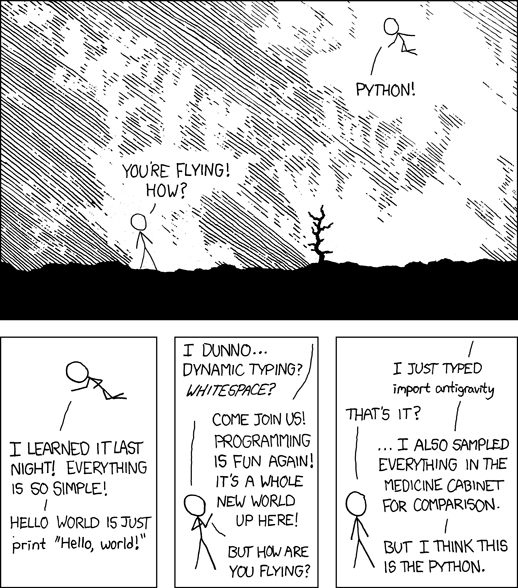
No longer did I have to worry about semicolons at the end of each line of my C code. Just write a small amount of code in an iterative environment and enjoy the rapid feedback process. But let’s just use the XKCD for that and move on.
Like Arithmetic Geometry, QFT, and General Relatively, Category Theory (CT) entered that awful category (awful pun intended) of things I felt a bit guilty about never learning correctly. I have picked up a few different books on the subject but never made it past the first two chapters. CT seemed like a helpful bookkeeping tool but a boring one to learn. As best as I could see, the most exciting thing CT could offer me was a natural way of generating algebraic structures in a topic I was unfamiliar with. If you are familiar with this idea, then naturally, you will understand this co-idea, but more on that later.
So how do you learning something you don’t really want to know but feel like you should? Why by learning something else entirely and sneaking in the unsavory learning on the down-low! Thus we have arrived at the goal of this series of posts. Helemskii’s book is reported to be both an introduction to CT and a motivation to learn the topic. At worst, I hope to at least not have to look up any basic definitions when using CT ((co)definitions?) after reading the book.
Why should I read a book on Functional Analysis when I already know Functional Analysis? One, multiple perspectives on the same topic enrich our depth of understanding. Or “Learn and relearn your field” by Terence Tao. Two, weird Russian books are just fun (Smooth Manifolds and Observables). Three, those brain cells seem to need a refresher from time to time if you want to retain things (Spaced Repetition).
Let the rolling book report begin… Next time 😉 [1/n!]
 This One Cool Trick Mathematicians Don't Want You To Know